
You are the Sun. ☀️
Haha, not literally! But in Snapchat’s Friend Solar System, you can be at the center—with your friends shown as planets around you.
So, what are Snapchat Planets? What does each planet mean? And how do people use this feature?
Let’s explore the planet order, how to check your position, and what it can tell you about your Snapchat friendships.
☀️ Snapchat Planets show your place in a friend's Best Friends list. There are eight planets. Mercury means first place. Neptune means eighth place.
The feature uses the same planet order as our real solar system.
But it tells you about activity on Snapchat, not how much someone loves you.
Let's start with the order. Then we'll look at how to see your planet, why it can change, and how to enjoy the feature without reading too much into it.
What Are Snapchat Planets?
Simply put, Snapchat Planets is the common name for Friend Solar Systems, a Snapchat+ feature.
When you view a friend's solar system, that friend is the Sun. You are one of the planets around them. Your planet shows your position in their Best Friends list.
Think of a friend called Alex. If you see yourself on Earth in Alex's solar system, you are third in Alex's list.
Note: Always ask, “Whose solar system am I looking at?” This helps you read the result correctly.
Snapchat Planet Order: All Eight Positions
The Snapchat planet order goes from Mercury to Neptune.
Position in their list | Planet | Simple meaning |
|---|---|---|
1st | Mercury | You are first in their Best Friends list. |
2nd | Venus | You are second in their list. |
3rd | Earth | You are third in their list. |
4th | Mars | You are fourth in their list. |
5th | Jupiter | You are fifth in their list. |
6th | Saturn | You are sixth in their list. |
7th | Uranus | You are seventh in their list. |
8th | Neptune | You are eighth in their list. |
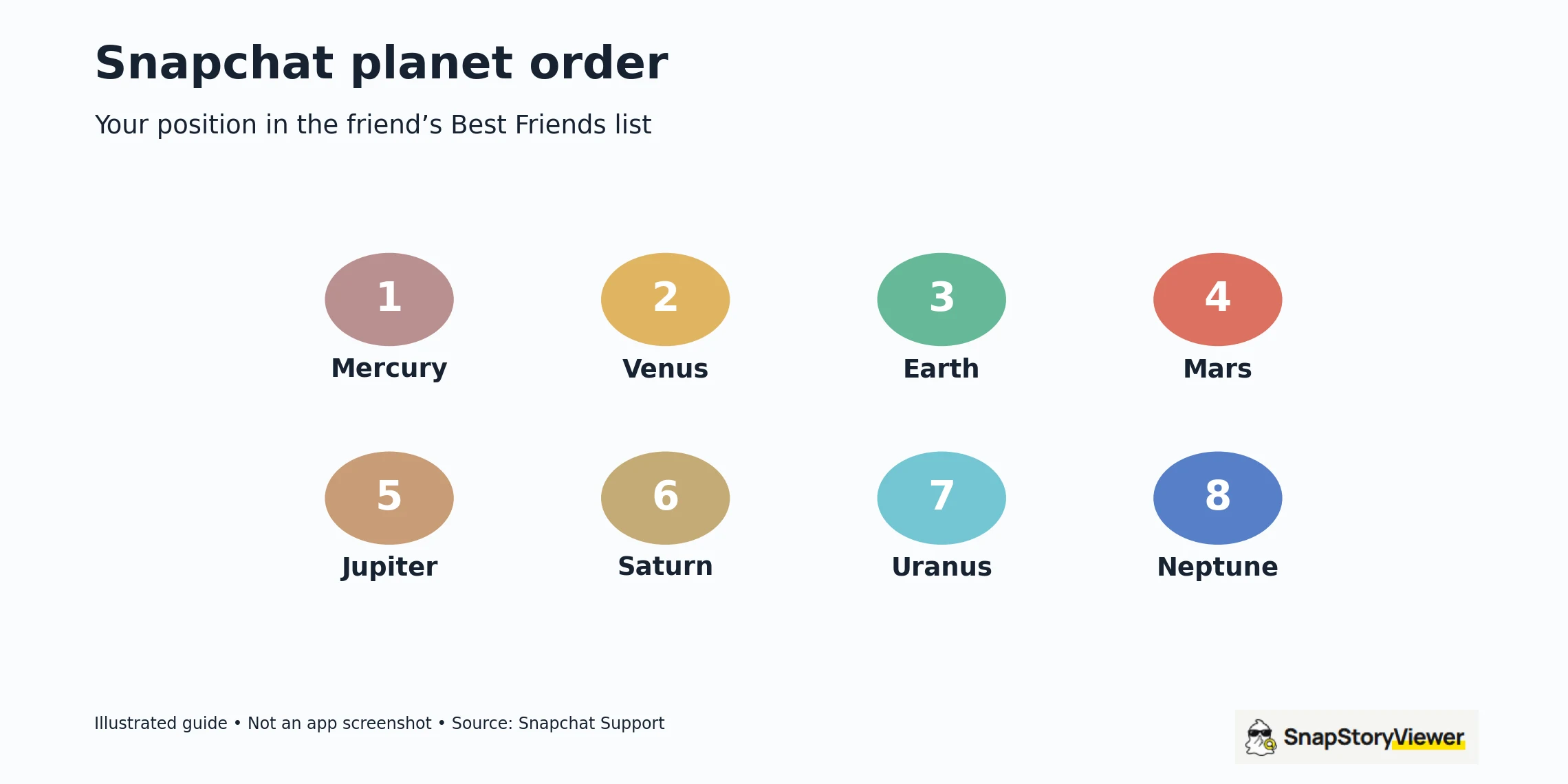
Chart: Snapchat's eight planet positions. This is a simple guide, not a screenshot of the app. Source: Snapchat Support.
Mercury and Venus: First and Second
Mercury is the first planet from the Sun. In Snapchat's system, it marks first place.
Venus is second. Seeing Venus means you are second in that friend's list.
Both are near the center of the picture. That makes them easy to read as “close.” Still, a place in an app is only one part of a friendship.
Earth and Mars: Third and Fourth
Earth means third place. Mars means fourth place.
These positions are still inside the eight-person list. Being on Mars does not mean you have been removed from it.
Jupiter and Saturn: Fifth and Sixth
Jupiter means fifth place. Saturn means sixth place.
A larger planet does not mean a higher position. Jupiter is the largest real planet, but it comes fifth in this order. Follow the name and position, not the size of the artwork.
Uranus and Neptune: Seventh and Eighth
Uranus means seventh place. Neptune means eighth place.
Neptune is the last planet in the feature. It does not mean “not a friend.” It means eighth in that person's Snapchat Best Friends list.
Tip: Save the chart if you keep forgetting the order. You only need to learn one sequence.
What Do the Planet Colors and Emojis Mean?
People often search for a “red planet,” “blue planet,” or “orange planet” on Snapchat.
Colors can help you recognise the picture. But a colour alone can be unclear. Several planet designs use similar shades.
Use the planet name and the order chart to confirm your place.
Do not decide that every blue-looking planet means the same position.
Hearts, stars, and other details are part of the artwork.
They do not give you a separate friendship score to calculate.
Also, planet pictures are different from the Friend Emojis beside names in Chat. A planet position and a heart emoji answer different questions.
How to See Snapchat Planets
Snapchat says this feature is available to Snapchat+ subscribers. It is switched off by default for first-time subscribers. You can turn it on in Snapchat+ feature management.
Open Snapchat and go to your profile.
Open your Snapchat+ feature settings.
Turn on Solar System if it is off.
Open a friend's Friendship Profile.
Look for a Best Friends badge with a gold ring.
Tap the badge to see your planet in their solar system.
Menu names or placement may change with app updates. Follow the labels in your version of Snapchat.
Note: This view shows your own place. It does not reveal a full list of everyone else around that friend.
Why Can't I See a Planet?
Check your subscription and Solar System setting first.
Then check that you are opening the Friendship Profile and tapping the right badge.
If the badge is missing, do not assume the app is broken.
Your relationship may not qualify for that view.
If the feature still seems wrong, update the app and check Snapchat Support. Avoid paying another website that claims it can reveal private planet rankings.
How Does the Snapchat Best Friends List Work?
Snapchat describes Best Friends as the people you Snap and Chat with most. You can have up to eight. The list changes regularly.
That is the useful starting point. Your planet relates to Snapchat activity.
The official help pages do not give an exact formula for predicting a position. They do not publish a set number of messages that guarantees Mercury.
So be careful with advice like “send 50 Snaps” or “wait exactly seven days.” Treat those claims as guesses unless Snapchat confirms them.
Tip: Talk to your friends because you want to talk to them. Chasing a planet can turn a normal chat into a task.
Can Your Planet Change?
Yes. A list that changes can give you a different position later.
For example, you may start chatting more with a classmate during a group project. A familiar friend may be quieter while they are busy. A change in app activity can change the picture you see.
These are examples, not a description of Snapchat's private formula.
There is no published schedule that lets you promise, “My planet will change tonight.”
Can Two Friends Have Different Planet Positions?
Yes. Your place in Alex's list and Alex's place in your list are two different things.
Imagine Alex is first in your list. You could still be third in Alex's list. Each person has their own set of chats and friends.
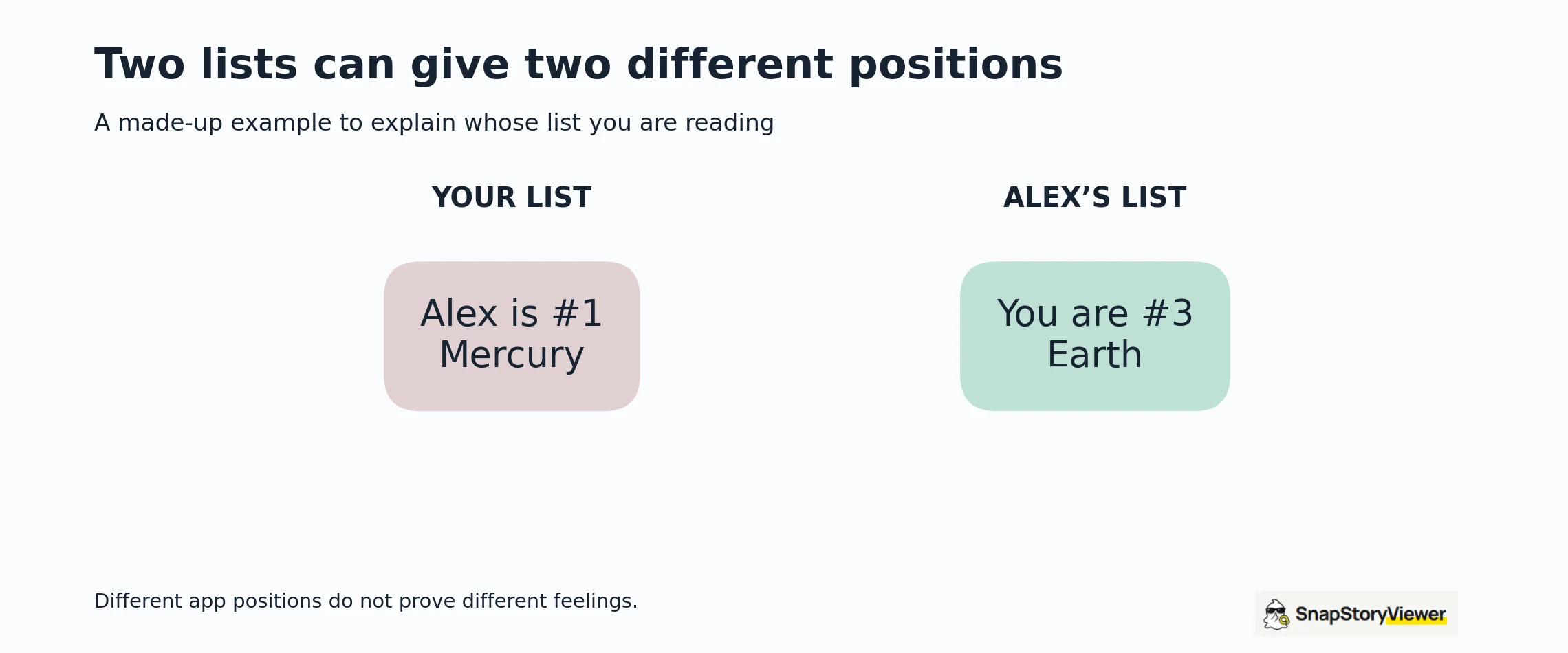
Example: You can hold different places in each other's lists. These are made-up names and positions to explain the idea.
This difference does not tell you why it happened. It also does not prove that one person cares more.
Why Snapchat Uses a Solar System ☀️
The idea is easy to picture. One person is at the center. Friends appear around them. A nearby planet suggests a closer position in the list.
We already use words like “close friend” and “inner circle.” A solar system gives those words a picture.
That is one way to understand why the design feels familiar. It is an explanation of the metaphor, not a claim about Snapchat's design research.
How It Connects to the Real Solar System
Our solar system has eight planets. Their order from the Sun is Mercury, Venus, Earth, Mars, Jupiter, Saturn, Uranus, and Neptune. Snapchat uses that same order.
Pluto is a dwarf planet. It does not appear as a ninth position in this feature.
In space, the gaps between planets are very different. The chart below shows their average distances from the Sun.
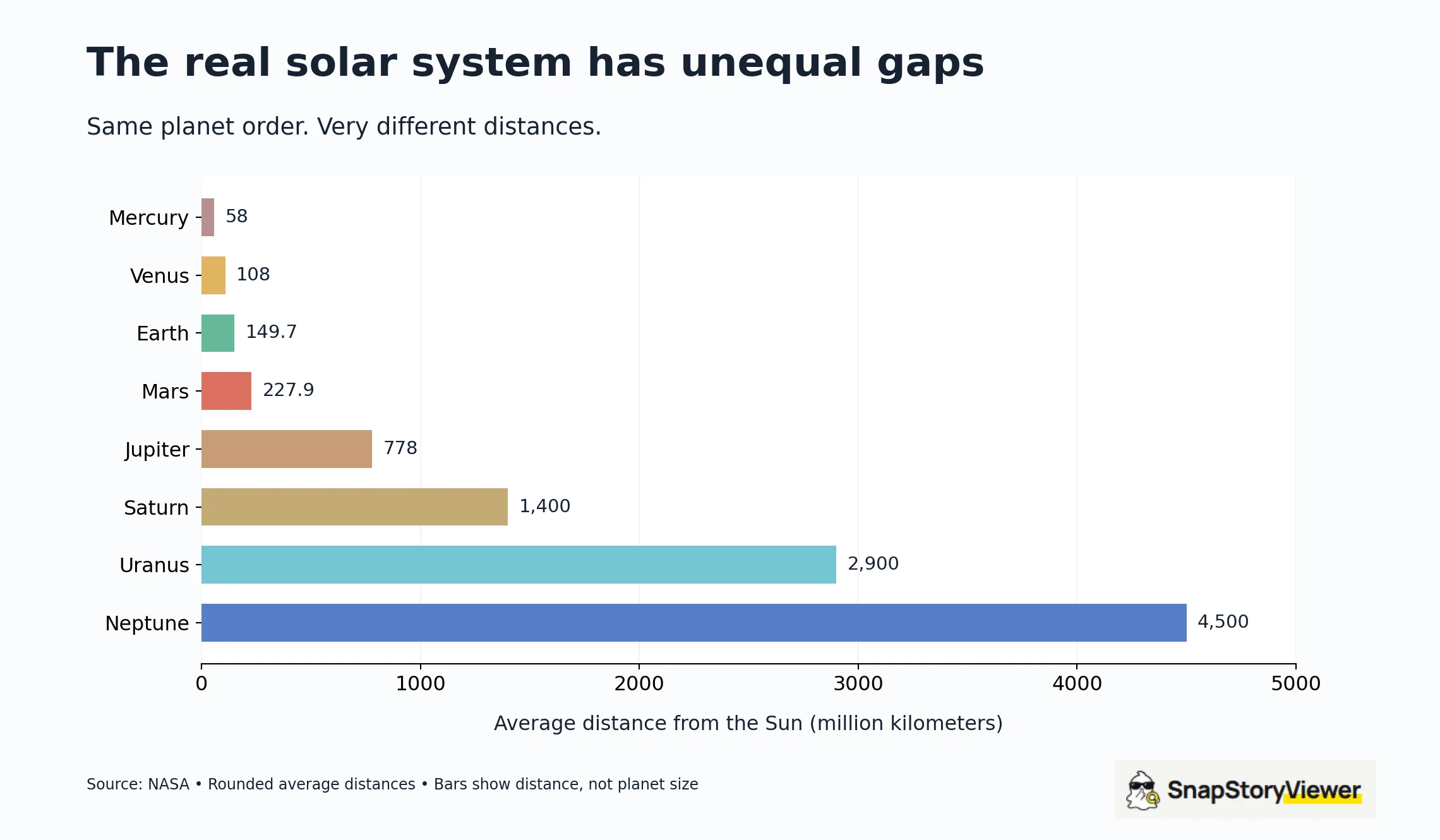
Chart: Average distance from the Sun, rounded as listed by NASA. The bars show distance, not planet size. Source: NASA.
Neptune is about 30 times as far from the Sun as Earth. But being Neptune on Snapchat does not mean a friend cares 30 times less about you.
The app borrows the order. It does not turn friendship into a distance you can measure.
Why a Small Planet Can Feel Like a Big Deal
You see Mercury and smile. Later, you see Saturn and wonder what changed.
That reaction is understandable. A picture can feel like an answer to a personal question: “How important am I to this friend?”
Snapchat has acknowledged that users may feel disappointed when a friendship looks less close than they hoped. In April 2024, it announced that Solar System would be off by default.
The Comparison Trap
A rank invites comparison. You might compare yourself with an earlier position or with someone else's screenshot.
But you cannot see the full story behind that picture. You do not know every conversation, schedule, or offline moment.
A friend who rarely uses Snapchat may still be the person who helps you most in real life.
A helpful reminder: A planet shows an app position. It cannot show trust, kindness, or years of shared memories.
What to Do If Your Planet Upsets You
Pause before sending a worried message. Ask yourself what you actually know. “My planet changed” is a fact. “My friend no longer likes me” is an interpretation.
If something feels wrong in the friendship itself, talk about that calmly. A direct conversation gives you more context than an icon.
You can also switch Solar System off. You do not need to keep checking a feature that makes chatting less enjoyable.
How Many People Use Snapchat Planets?
There is no current public total for Snapchat Planets users in the official sources reviewed for this guide.
Here are the numbers Snapchat has published. They measure different things.
What is counted? | Published figure | Date or period |
|---|---|---|
Snapchat monthly active users | 971 million | Q2 2026 |
Snapchat+ subscribers | More than 25 million | July 16, 2026 |
Daily use of Solar System | Less than 0.25% of the Snapchat community, on average | April 5, 2024 statement |
The first number covers Snapchat as a whole. The second covers a paid subscription with many features.
Neither tells us how many people currently use Planets. The 2024 figure is historical and refers to daily use. It is not today's total.
Note: A high search volume for “Snapchat planets” is not a user count either. People may search more than once, and related keyword estimates can overlap.
Can a Public Story Viewer Show Snapchat Planets?
A public Story and a private Friendship Profile are different parts of Snapchat.
A tool for viewing public Stories should not be treated as a way to discover someone's private Best Friends list or planet positions.
If you are reading this on SnapStoryViewer, use Snapchat itself to check Friend Solar Systems. Public Story viewing does not reveal private friendship rankings.
Quick Answers
What is the number-one Snapchat planet?
Mercury. It means first place in the friend's Best Friends list you are viewing.
What does Venus mean on Snapchat?
Venus means second place.
What does Earth mean on Snapchat?
Earth means third place.
What does Mars mean on Snapchat?
Mars means fourth place.
What does Saturn mean on Snapchat?
Saturn means sixth place. Jupiter comes before it in fifth place.
Is Neptune a bad sign?
Neptune means eighth place. That alone does not tell you whether the friendship is good or bad.
Does Mercury mean we are dating?
No. A planet position does not confirm a romantic relationship.
Are Snapchat Planets the same as a Snapstreak?
No. A Snapstreak tracks consecutive days of sending Snaps back and forth. Planets show positions in a Best Friends list.
Can I check the whole list around a friend?
The Solar System view does not show the other friends in that person's system.
Enjoy the Planets, Keep the Friendship in View
Snapchat Planets make a list easier to picture. Once you know the eight-planet order, the feature is simple to read.
Check whose solar system you are viewing. Remember that positions can change. And keep the result in context.
Your friendship has more to it than the Snaps and Chats an app can count. Enjoy the picture, then get back to the conversation.